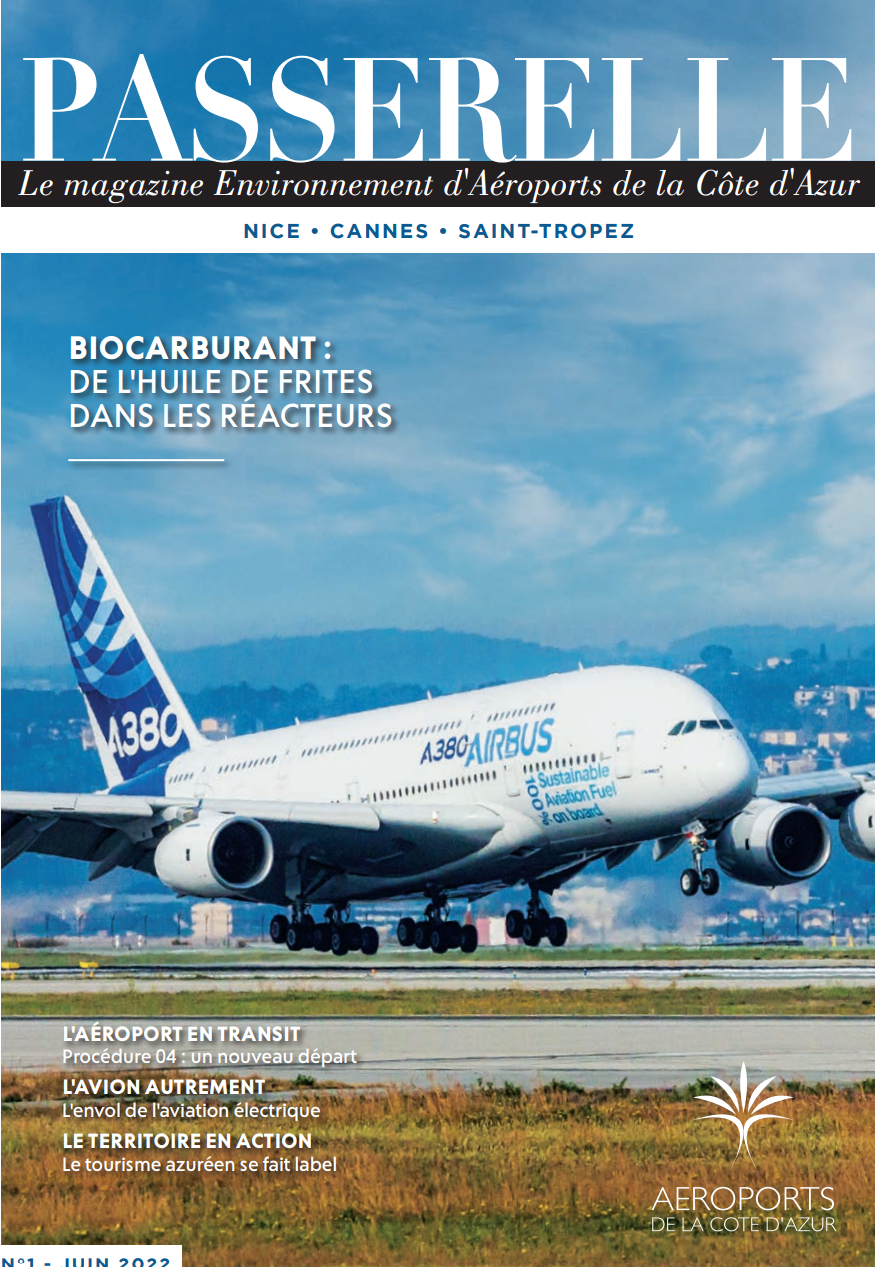
Passerelle N°5 – Environment magazine from Aéroports de la Côte d’Azur
Passerelle invites you to take a transparent look at the progress made by Nice Côte d’Azur, Cannes Mandelieu and Golfe de Saint-Tropez airports. There can be no confidence in the future without an honest assessment of the present.
Published on 29-01-24
The two airports have announced that their thermal vehicles that cannot be converted to all-electric engines will now be fueled with biodiesel, a fuel that represents an 80% reduction in CO2 emissions over its entire lifecycle.
From now on, fire trucks, refueling trucks, agricultural machinery and the auxiliary power units used to supply electricity to aircraft in stopover are fueled with biodiesel at Cannes-Mandelieu airport. This fuel, dubbed “HVO 100”, is produced from waste products such as used edible oils, animal fats and by-products from the paper pulp sector. It is the only internationally recognized biofuel for 100% use, and complies with EN 15940. Over the entire lifecycle, it represents a saving of at least 80% in CO2.
The two airports, already holders of Airport Carbon Accreditation level 4+, are thus extending their efforts to decarbonize their ground handling operations.
For Cannes-Mandelieu airport, with an annual consumption of 20,000 liters of diesel, the switch to biodiesel represents a further saving of 42 tons of CO2 equivalent per year, since one liter of diesel emits 2.67 kg of CO2. This volume represents half the residual emissions of the Mandolieu airport.
The Golfe de Saint-Tropez airport has made the same commitment, which will be deployed when the hub reopens on March 15. With an annual consumption of 4,000 liters of diesel, switching to biodiesel represents a saving of 8.5 tons of CO2 equivalent per year.
As a result, both airports are implementing the actions required to reduce their emissions in absolute terms, according to schedule.
This new contribution to Aéroports de la Côte d’Azur’s decarbonization policy extends the environmental gains already made by the electrification of compatible vehicles, all ground handling operations, the installation of anti-smog boxes reducing fine particle emissions from thermal vehicles by over 80%, and the elimination of gas-fired boilers for terminal temperature control.
“No effort should be spared to reduce the carbon footprint of our activities on our territory. Technological developments, far from being the only solutions to be envisaged, represent opportunities that must be seized without delay to achieve carbon neutrality as quickly as possible, without compensation. Our roadmap is clear, and we are committed to achieving carbon neutrality by 2030”
, says Franck Goldnadel, Chairman of the Board of Aéroports de la Côte d’Azur.
The-two-aeroports-announce-that-their-thermal-vehicles-cannot-change-over-to-an-all-electric-motorization-will-be-2sDownload
Passerelle invites you to take a transparent look at the progress made by Nice Côte d’Azur, Cannes Mandelieu and Golfe de Saint-Tropez airports. There can be no confidence in the future without an honest assessment of the present.
Aéroports de la Côte d’Azur, which has just been awardedAirport Carbone Accreditation level 4+, is now aiming for full carbon neutrality without offsetting by 2030.
Aéroports de la Côte d’Azur, operator of the Nice-Côte d’Azur, Cannes-Mandelieu and Saint-Tropez-la-Môle hubs, has made a firm commitment to achieve carbon neutrality without offsetting by 2030 – 20 years earlier than the global commitments made at COP21. In 2018, the group was the first in France to obtain Airport Carbone Accreditation level 3+, certifying its carbon neutrality by offsetting its residual emissions.
In 2020, it will begin reforestation operations, either directly on its own property for the Golfe de Saint-Tropez airport, or in neighboring communes for the Cannes-Mandelieu and Nice Côte d’Azur airports. This step, unprecedented in France, creates natural carbon sinks, absorbing up to 300 tonnes of CO2 equivalent per year as the trees grow.
Finally, between 2018 and 2019, a decisive step was taken as all three platforms managed to reduce their direct emissions in absolute terms: -4.4% for Nice-Côte d’Azur, -20% for Cannes-Mandelieu and -27% for the Golfe de Saint-Tropez airport. Less emissions, despite traffic growth, more absorption, directly on their territories: Aéroports de la Côte d’Azur is now the first in France to obtain the brand-new, and most demanding, Airport Carbon Accreditation level 4+, and the 2nd in Europe.
” Obtaining Airport Carbon Accreditation level 4+ is not a medal, and even less a false nose for greenwashing. It is the international recognition of a sincere commitment and an ambitious, unprecedented action plan. When we reduce our direct emissions, in absolute terms, we preserve our territory. This involves numerous actions, the implementation of innovations, and the daily search for solutions to reconcile air transport with air quality requirements. “Franck Goldnadel, Chairman of the Board of Aéroports de la Côte d’Azur.
Our commitment is to respond to every complaint we register in 2020. These complaints come from local residents, residents’ associations or institutions (town halls).
With our environment and communications departments at ANCA and the DSAC, we have set up a working and communication method.
Noise monitoring :
- Remind crews to follow trajectories and make sure they are working properly.
- Limitation of low-level passes by army helicopters.
- Limits APU use to 30min.
- Respect for trajectories during training and pilot qualification.
- Stop all training if procedures are not followed.
- Compilation of complaints and requests for information in close collaboration with government departments (DSAC, SNA, BGTA).
- Acoustic measurement campaigns on request.